Sensex, Nifty, and the Indian Stock Market
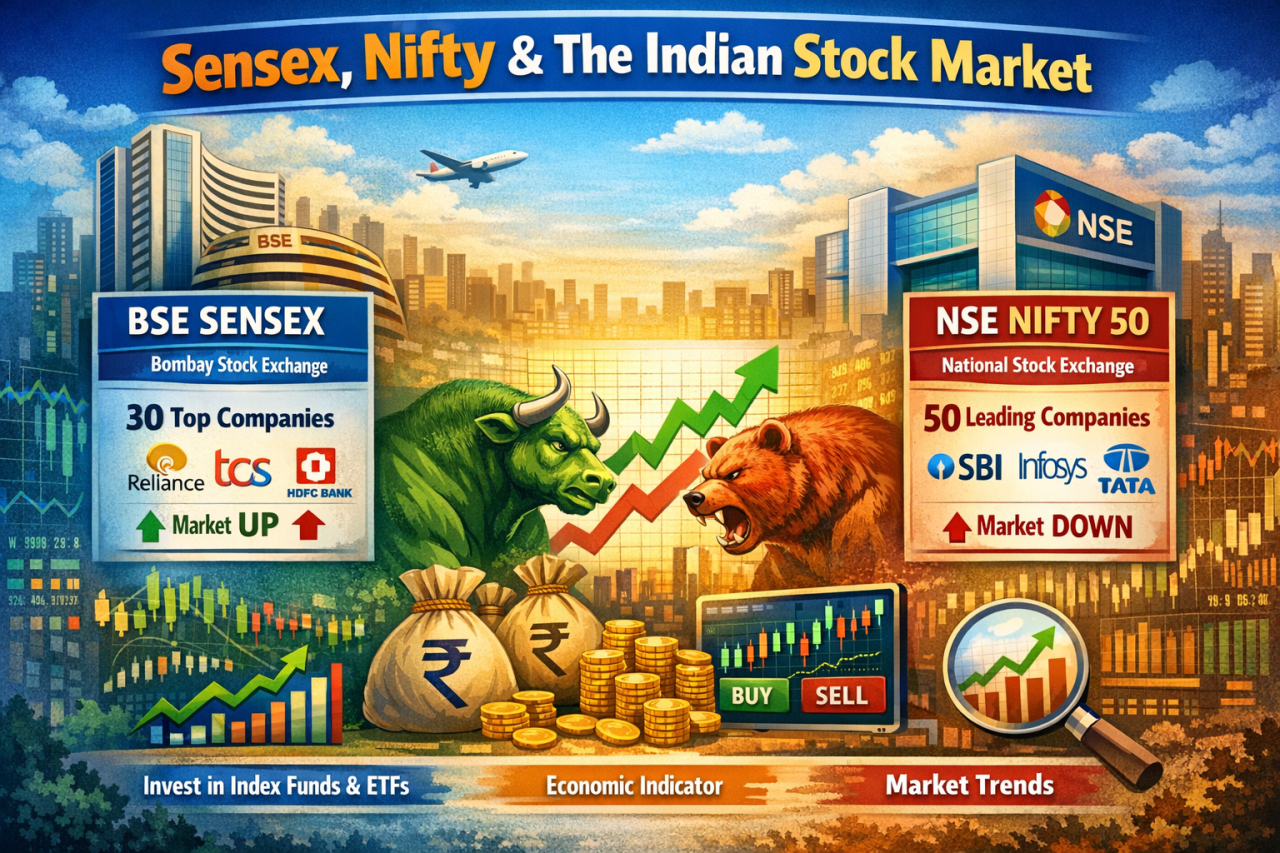
Sensex, Nifty, and the Indian Stock Market
1. What Is the Stock Market? (Very Basic Understanding)
The stock market is a place where people buy and sell shares of companies.
What is a Share?
· A share means ownership in a company.
· When you buy a share, you become a small owner of that company.
· If the company grows and earns profit, the value of your share can increase.
· Some companies also pay dividends (a part of profit) to shareholders.
Why Do Companies Sell Shares?
Companies sell shares to:
· Raise money for business growth
· Expand operations
· Launch new products
· Pay debts
Why Do People Buy Shares?
People buy shares to:
· Grow their money
· Earn dividends
· Beat inflation
· Build long-term wealth
2. Stock Exchanges in India
A stock exchange is an organized platform where shares are traded safely and legally.
India has two major stock exchanges:
1. BSE – Bombay Stock Exchange
· Established in 1875
· Oldest stock exchange in Asia
· Its main index is Sensex
2. NSE – National Stock Exchange
· Established in 1992
· Most modern and largest exchange in India
· Its main index is Nifty 50
3. What Is an Index?
An index is like a scoreboard or thermometer of the stock market.
· It shows whether the market is going up or down
· It represents the performance of a group of top companies
· Instead of tracking thousands of stocks, people track indices
👉 Sensex and Nifty are stock market indices
4. What Is Sensex? (Detailed Explanation)
Sensex stands for Sensitive Index.
What Does Sensex Represent?
· Sensex tracks the performance of 30 biggest and strongest companies listed on the BSE.
· These companies are leaders in their industries.
Examples of Sensex Companies:
· Reliance Industries
· TCS
· Infosys
· HDFC Bank
· ICICI Bank
· Hindustan Unilever
Why Only 30 Companies?
Because these 30 companies:
· Are financially strong
· Have high market value
· Represent different sectors of the economy
Together, they show how the Indian economy is performing.
5. How Sensex Is Calculated (Simple Explanation)
Sensex is calculated using:
Free-Float Market Capitalization Method
Market Capitalization:
Market Cap = Share Price × Total Shares
Free-Float:
· Only shares available for public trading are considered
· Shares held by promoters or government are excluded
Important Point:
· Big companies affect Sensex more
· If a large company’s price changes, Sensex moves strongly
6. What Is Nifty 50? (Detailed Explanation)
Nifty 50 is the benchmark index of the NSE.
What Does Nifty 50 Represent?
· Nifty consists of 50 large and liquid companies
· Covers about 65% of the total market value of NSE
· More diversified than Sensex
Examples of Nifty 50 Companies:
· Reliance Industries
· State Bank of India (SBI)
· Tata Motors
· ITC
· Infosys
· Axis Bank
7. How Nifty 50 Is Calculated
· Uses Free-Float Market Capitalization
· Companies are reviewed every 6 months
· Stocks can be added or removed based on performance
8. Difference between Sensex and Nifty (Detailed Table)
|
Feature |
Sensex |
Nifty 50 |
|
Stock Exchange |
BSE |
NSE |
|
Number of Companies |
30 |
50 |
|
Year Launched |
1986 |
1996 |
|
Market Coverage |
Smaller |
Wider |
|
Used by Traders |
Less |
More |
|
Options Trading |
Limited |
Very High |
9. Why Sensex and Nifty Move Up or Down
Major Reasons:
1. Company profits or losses
2. Interest rate changes
3. Inflation data
4. Government policies & budget
5. Global markets (USA, Europe, China)
6. Foreign investors (FII/DII) buying or selling
7. Rupee vs Dollar exchange rate
10. What Does Sensex/Nifty Rising or Falling Mean?
When Sensex or Nifty Rises:
· Most big companies are doing well
· Investors are confident
· Economy is strong
When Sensex or Nifty Falls:
· Investors are worried
· Companies may be facing problems
· Economic uncertainty exists
11. Can You Buy Sensex or Nifty Directly?
❌ No, you cannot buy the index directly.
But You Can Invest Through:
1. Index Mutual Funds
· Invests in all Sensex or Nifty companies
· Low risk compared to individual stocks
· Ideal for beginners
2. ETFs (Exchange Traded Funds)
· Traded like shares
· Tracks index performance
3. Futures & Options (Advanced)
· Used by professional traders
· High risk
· Not recommended for beginners
12. Sensex & Nifty for Beginners – Which Is Better?
For Long-Term Investors:
· Nifty 50 is better due to more diversification
For Safe Investment:
· Index mutual funds are best
For Trading:
· Nifty is more popular because of high liquidity
13. Simple Example for Easy Understanding
Imagine:
· Reliance, TCS, and HDFC Bank prices go up
· These are heavy-weight stocks
· Sensex and Nifty increase
If these stocks fall:
· Indices fall sharply
14. Summary (Easy Words)
· Stock market is where company shares are traded
· Sensex shows performance of 30 top companies on BSE
· Nifty 50 shows performance of 50 top companies on NSE
· Both indicate market health
· You can invest through index funds or ETFs
· Long-term investment is safer than short-term trading
Read More
Sensex, Nifty, and the Indian Stock Market